Family Financial Centers Franchise FDD, Costs & Fees (2026)
Family Financial Centers is a financial services franchise providing check cashing, bill payment, and small business banking solutions.
KEY FRANCHISE STATS
Franchisees
?
55
+
4%
4%
Franchise fee
?
$40,500
Investment
?
$224,000 - $309,000
Revenue (AUV)
?
Undisclosed
$151,000
+
n.a.
n.a.
Sign up
Family Financial Centers (FFC) was founded in 2004 by Paul W. Eckert in response to the rapid decline of neighborhood bank branches. Headquartered in Doylestown, Pennsylvania, the company began franchising the same year it was established. Since then, it has grown into a network of over 50 franchise locations across the United States.
The franchise is designed to serve the financial needs of small businesses, middle-income workers, and the unbanked population by offering an alternative to traditional banking.
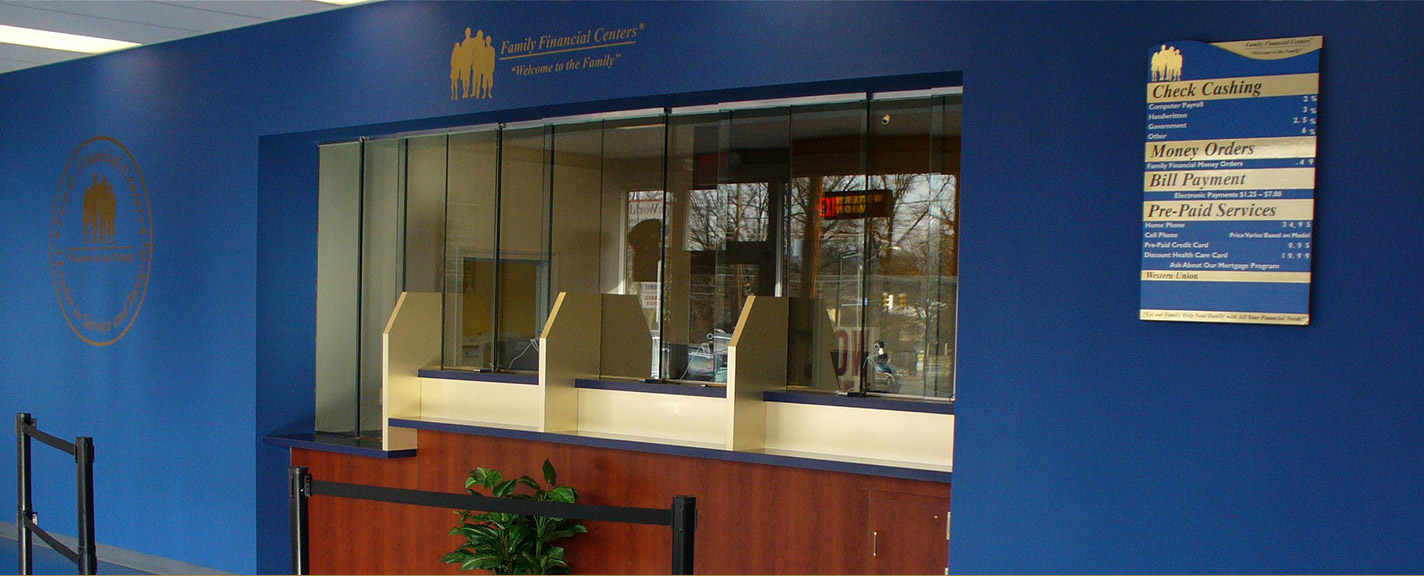
FFC provides a comprehensive range of services, including check cashing, money transfers, bill payments, prepaid debit cards, and tax preparation. These services are delivered in a professional setting that mirrors the look and feel of a traditional bank, making financial transactions both convenient and customer-friendly.
With a focus on technology, the franchise utilizes advanced software and security systems to ensure speed, accuracy, and safety in every transaction.
Interested in Family Financial Centers franchise?
Share your information and our team will help you explore Family Financial Centers franchise opportunity, including startup costs, available territories, ownership requirements, and next steps.
The initial investment required for a Family Financial Centers franchise is
$224,000 - $309,000.
That is the total cost you would need to finance if you were to start this franchise.
These costs are provided by the franchisor in the Franchise Disclosure Document.
Type of Expenditure
Amount
Initial Franchise Fee
$40,500
Lease Deposit
$1,000 to $3,000
Construction and Build-out
$27,500
Furniture, Fixtures, and Equipment
$83,000
Opening Inventory
$60,000
Opening Advertising
$3,000 to $5,000
Initial Training
$1,000 to $2,000
Licensing Fees
$3,000 to $4,000
Customer Identification Software
$70
Additional Funds (3 months)
$5,400 to $33,600
Certificate of Deposit
$0 - $50,000
Total
$224,470 to $308,670
Create a free account to access this table and more.
Thank you! Your submission has been received!
Oops! Something went wrong while submitting the form.
Type of Expenditure
Amount
Initial Franchise Fee
$40,500
Lease Deposit
$1,000 to $3,000
Construction and Build-out
$27,500
Furniture, Fixtures, and Equipment
$83,000
Opening Inventory
$60,000
Opening Advertising
$3,000 to $5,000
Initial Training
$1,000 to $2,000
Licensing Fees
$3,000 to $4,000
Customer Identification Software
$70
Additional Funds (3 months)
$5,400 to $33,600
Certificate of Deposit
$0 - $50,000
Total
$224,470 to $308,670
Franchise Disclosure Document
Below is Family Financial Centers's 2024 Franchise Disclosure Document. Sign up for free to view the document.
Number of units
Family Financial Centers had 55 total units in 2024, of which 55 were franchised-owned and 0 company-owned.
Family Financial Centers offers a structured training program to prepare franchisees for successfully operating their Financial Center. The training is mandatory for the Operating Principal and can include others based on availability. It consists of two main components:
Initial Training Program This program spans 5 to 7 days and is conducted at the corporate headquarters in Doylestown, Pennsylvania, or virtually if necessary. The program includes classroom instruction covering check cashing procedures, compliance with the Bank Secrecy Act and Anti-Money Laundering protocols, customer service, marketing, and human resources. This classroom training accounts for 39 hours, with an additional 38 hours of on-site instruction at the franchisee’s location.
Ongoing and Supplemental Training Franchisees and their managers may be required to attend additional sessions such as annual conferences, refresher courses, and training on updated business practices. These cover areas like sales techniques, personnel training, inventory control, and marketing.
Territory Protection
Family Financial Centers provides franchisees with a designated “Site Selection Area” in which they are permitted to establish their Financial Center. This area is mutually agreed upon at the time the Franchise Agreement is signed, and franchisees must secure a site within 180 days.
However, the franchise disclosure document does not mention any exclusive territorial rights or protections preventing the franchisor from opening other franchises or company-owned centers nearby.
While the agreement formalizes a protected location for opening, it does not prohibit Family Financial Centers or other franchisees from operating in adjacent areas. The franchisor also reserves the right to terminate the agreement if the franchisee fails to meet opening deadlines. Therefore, while there is site approval and a geographic scope for setup, it should not be mistaken for full territory exclusivity or protection.



.png)