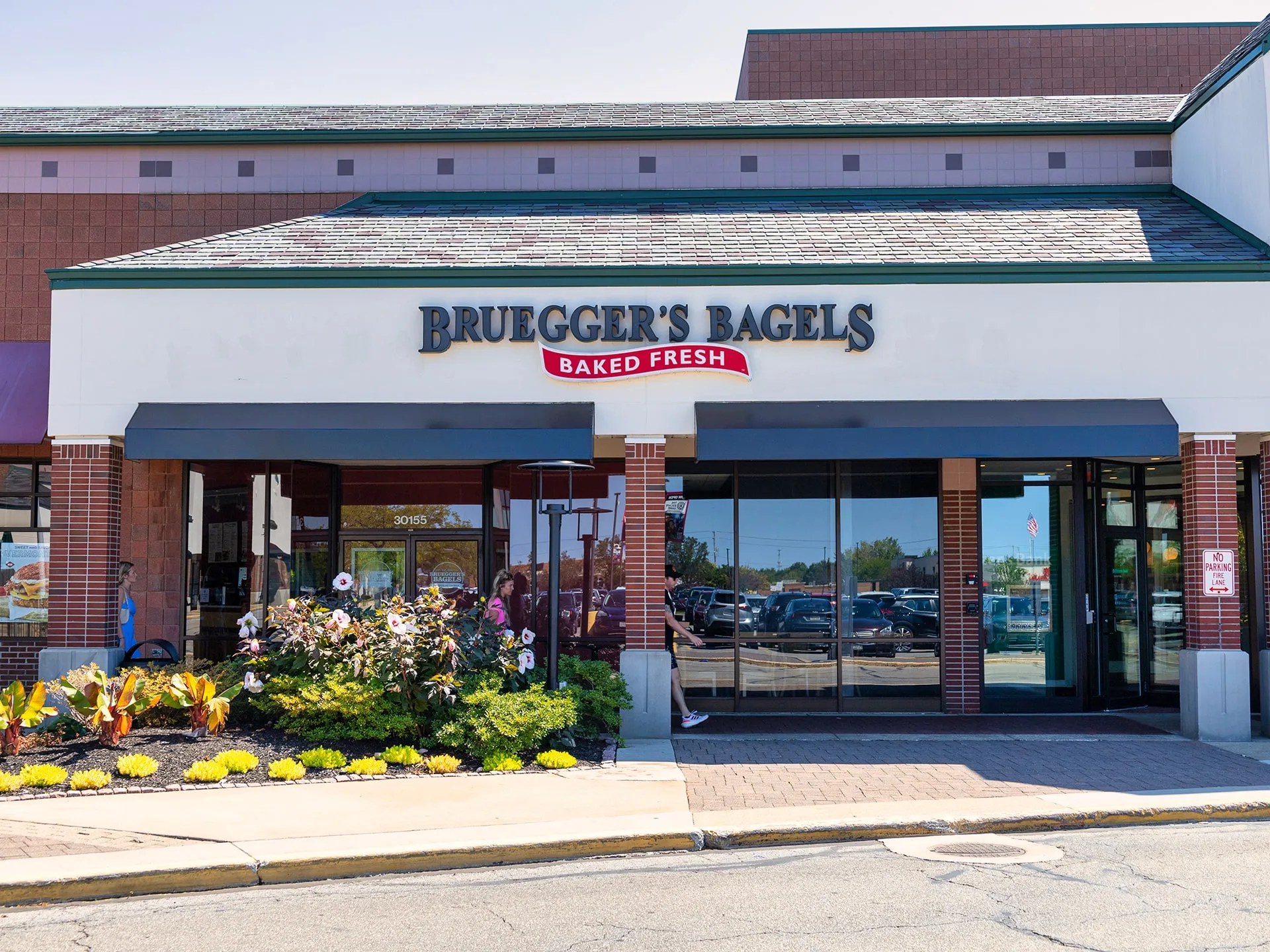

Bruegger’s Bagels is a fast-casual bakery-café known for authentic New York–style bagels and premium coffee. The company was founded in 1992 by Nordahl Brue and Mike Dressell, who opened their first location in Troy, New York. Today, the brand is headquartered in Burlington, Vermont, and operates as Bruegger’s Enterprises, Inc., a subsidiary of JAB Holding Company.
Bruegger’s began offering franchise opportunities in 1993, helping the brand expand across the United States and Canada. At its peak, Bruegger’s operated over 300 bakery-cafés in 26 states, Washington D.C., and Canada. Currently, the chain has about 190 locations in 16 U.S. states and D.C.
The menu features kettle-boiled bagels baked fresh daily, along with a variety of made-in-Vermont cream cheeses. Customers also enjoy breakfast and lunch sandwiches, soups, salads, and a full beverage menu including coffee and espresso drinks.
Bruegger’s sets itself apart by sticking to traditional methods—using only five core ingredients in its bagels and boiling them in small batches every morning for a fresh, authentic result.
Here's what you would need to invest if you were to start this franchise. These costs are provided by the franchisor in the Franchise Disclosure Document.
Bruegger’s Bagels provides detailed training for its franchisees to ensure successful operation of their bakery locations. The training programs offered by the franchisor include the following:
Bruegger’s Bagels does not grant exclusive territories to its franchisees. The franchise agreement permits Bruegger’s to establish additional franchises or company-owned bakeries at any location, even in close proximity to an existing franchisee’s bakery.
This means franchisees do not have a contractually protected geographic area where competition from other Bruegger’s outlets is restricted. However, while the franchisor reserves broad rights to open new locations, they typically consider market saturation and demographic factors when awarding new franchises.
Franchisees are encouraged to perform due diligence about their intended area and assess potential competitive risks before signing. This arrangement provides Bruegger’s with the flexibility to expand but may limit territorial security for franchisees.
Below are some of
Bruegger's Bagels
key competitors in the
Baked Goods
sector.
48
$35,000
$694,000
$1,227,000
n.a.
$0
$xxx,xxx
n.a.
n.a.
n.a.
n.a.

Al Manakeesh is a Middle Eastern bakery-restaurant brand offering manakeesh flatbreads, shawarma, and Lebanese specialties, serving neighborhood diners and families, and known for freshly baked dough, traditional flavors, and casual, counter-service settings that highlight Levantine comfort food.
?
?

Golden Krust Caribbean Restaurant is a quick‐service franchise offering Caribbean-style patties, rotis, rice dishes and meals, serving diaspora communities and casual diners, and known for signature flavors, cultural brand heritage and growing franchise network.
?
?

MidnighTreats is a late-night food-truck or small-format franchise offering waffles, desserts and sweet-snacks on-demand, serving late-night crowds, event patrons, and dessert lovers, and known for mobile flexibility, viral menu appeal and lean startup model.
?
?

Schmackary’s is a gourmet cookie-and‐dessert franchise offering handmade cookies, ice cream sandwiches, and specialty treats, serving dessert lovers and gift buyers, and known for bold flavors, urban brand presence and experiential retail-tainment.
?
?

BAGEL BOSS is a bagel-and-deli franchise offering New York–style bagels, breakfast sandwiches, deli items and coffee, serving morning commuters and families, and known for authentic bagel craft, strong local presence and franchise scalability.
?
?

House of Bread is a bakery-café franchise offering freshly baked artisan breads, pastries, sandwiches and café meals, serving families and casual diners, and known for hand-crafted baking, community-driven brand and multi-stream revenue.
?
?
Choosing a franchise goes beyond reviewing fees and financials — it requires an honest assessment of your goals, skills, and risk tolerance. This article outlines the key questions prospective owners should ask before committing. It helps clarify whether the opportunity aligns with your lifestyle, long-term plans, and operational preferences.
Speaking with current and former franchisees is one of the most reliable ways to understand how a franchise really operates. This guide explains how to conduct validation calls, what questions to ask, and how to identify patterns in feedback. It provides a practical framework for uncovering real performance expectations and support quality.
Not all franchise opportunities offer the same potential. This article breaks down how to evaluate a brand’s industry, financial health, support systems, and competitive positioning. It helps prospective buyers compare options and identify franchises with strong long-term viability.
A clear, well-structured business plan is essential for securing financing and preparing for the realities of franchise ownership. This article explains how to build a plan that covers market analysis, operations, staffing, and local marketing. It also outlines how to create realistic pro forma financials, including revenue projections, startup costs, and break-even analysis. Readers gain a practical framework they can use when applying for loans or planning their first years of operations.