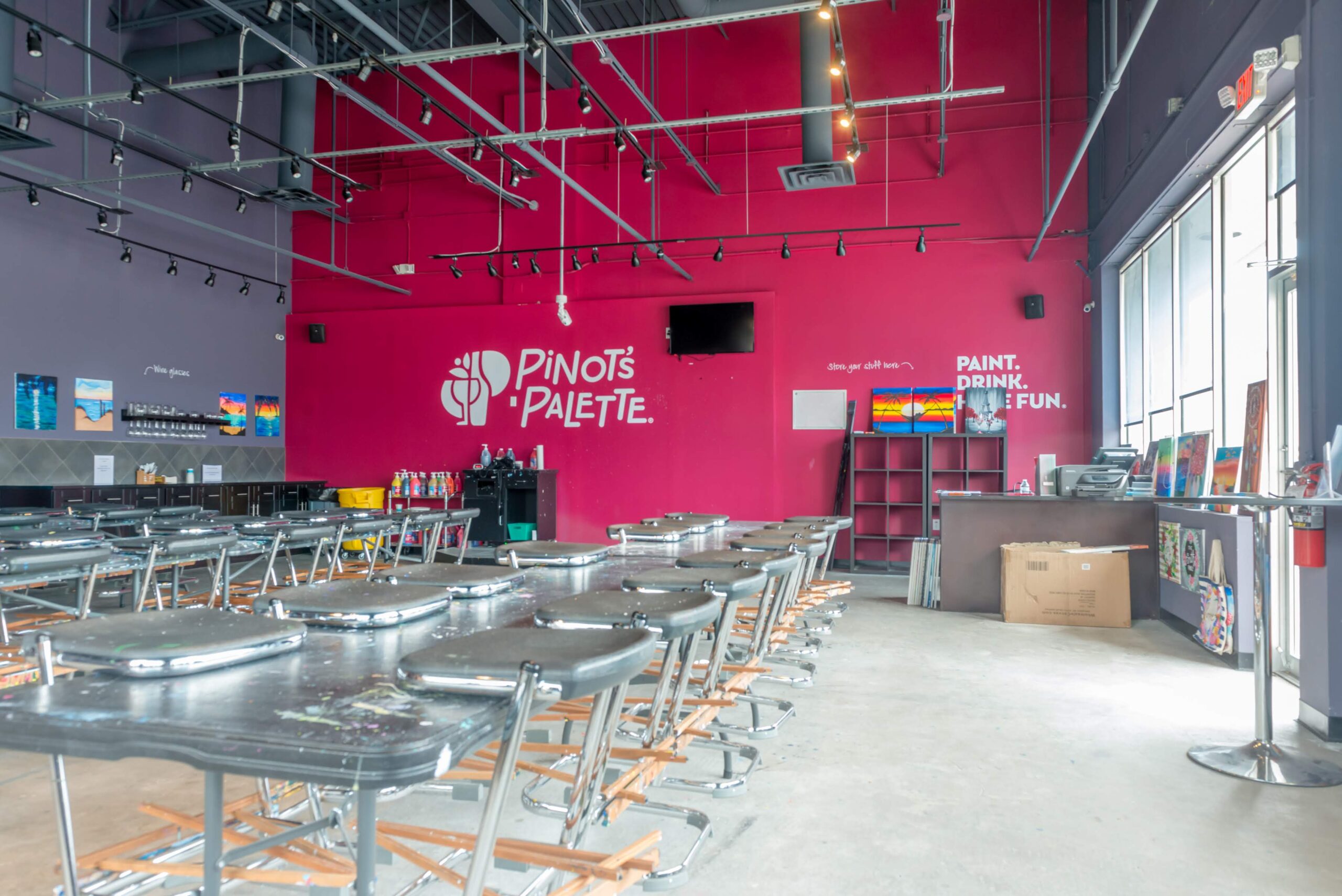

Pinot’s Palette is a popular “paint and sip” franchise that offers step-by-step painting classes combined with a social wine experience. Guests create their own canvas art in a fun, relaxed studio environment while enjoying wine or cocktails.
Depending on local regulations, studios operate as BYOB or serve beverages on-site. The concept blends art instruction with entertainment, making it ideal for date nights, girls’ nights out, and private events.
The franchise was founded in 2009 in Houston, Texas, by Craig Ceccanti, Beth Willis, and Charles Willis. Originally named “Pinot and Picasso,” the brand changed its name to Pinot’s Palette in 2010. It remains headquartered in the Houston area and has grown steadily through a combination of corporate leadership and franchisee support.
Pinot’s Palette began franchising in 2010, with its first franchise location opening in Katy, Texas. The concept quickly gained momentum and became one of the fastest-growing paint and sip franchises in the U.S. It also expanded internationally, opening its first Canadian location in 2015
Here's what you would need to invest if you were to start this franchise. These costs are provided by the franchisor in the Franchise Disclosure Document.
Pinot’s Palette provides a comprehensive training program designed to prepare franchisees for the successful launch and operation of their business. Below are the core training components offered by the franchisor:
Pinot’s Palette does not grant its franchisees exclusive territorial rights. Franchisees are expected to operate at a specific approved location and are not provided any assurance that another Pinot’s Palette location won’t be opened nearby. The franchisor retains discretion to evaluate and approve additional franchise sites within close proximity, based on market conditions and business strategy.
Even though Pinot’s Palette may assist with site selection and review leases for new locations, it does not limit itself from approving additional units in the same region. This lack of exclusive territory means franchisees could face internal competition. Franchisees must therefore focus on local marketing and service quality to maintain a competitive edge within the broader system.
Below are some of
Pinot's Palette
key competitors in the
Arts / Sports
sector.
72
$30,000
$101,000
$271,000
n.a.
$380,000
$xxx,xxx
n.a.
n.a.
n.a.
n.a.

Funtastik Labs is a children’s enrichment franchise offering STEM, art, and slime labs through camps, parties, and classes, serving families seeking educational play experiences, and known for hands-on experiments, birthday events, and repeatable programs that turn curiosity into recurring revenue.
?
?

Musicologie is a music-education franchise offering group and private lessons across instruments and voice, serving children, teens, and adult learners, and known for neighborhood studios, playful curricula, and community-focused recitals that make music education approachable, fun, and accessible for families.
?
?

Rockstars of Tomorrow is a music-education franchise offering instrument lessons, band programs, and performance coaching, serving kids, teens, and adults, and known for immersive studio environments, stage-focused training, live shows, and a modern curriculum emphasizing collaboration and real-world performance.
?
?

Singers Company is a children’s enrichment franchise offering singing and performance groups for young girls, serving families seeking positive extracurricular activities, and known for age-appropriate songs, modest costumes, uplifting choreography, and confidence-building recitals in a supportive, fun, and non-competitive environment.
?
?

Global Art is a children’s education franchise offering structured art classes and creative programs, serving kids seeking enrichment beyond school, and known for a proprietary curriculum, international presence, and focus on building creativity, confidence, and problem-solving through drawing and design.
?
?

Gracie Barra is a martial-arts franchise offering Brazilian jiu-jitsu classes and self-defense training for kids and adults, serving all-age students, and known for uniform curriculum, global network, and values-based training environment.
?
?
Choosing a franchise goes beyond reviewing fees and financials — it requires an honest assessment of your goals, skills, and risk tolerance. This article outlines the key questions prospective owners should ask before committing. It helps clarify whether the opportunity aligns with your lifestyle, long-term plans, and operational preferences.
Speaking with current and former franchisees is one of the most reliable ways to understand how a franchise really operates. This guide explains how to conduct validation calls, what questions to ask, and how to identify patterns in feedback. It provides a practical framework for uncovering real performance expectations and support quality.
Not all franchise opportunities offer the same potential. This article breaks down how to evaluate a brand’s industry, financial health, support systems, and competitive positioning. It helps prospective buyers compare options and identify franchises with strong long-term viability.
A clear, well-structured business plan is essential for securing financing and preparing for the realities of franchise ownership. This article explains how to build a plan that covers market analysis, operations, staffing, and local marketing. It also outlines how to create realistic pro forma financials, including revenue projections, startup costs, and break-even analysis. Readers gain a practical framework they can use when applying for loans or planning their first years of operations.