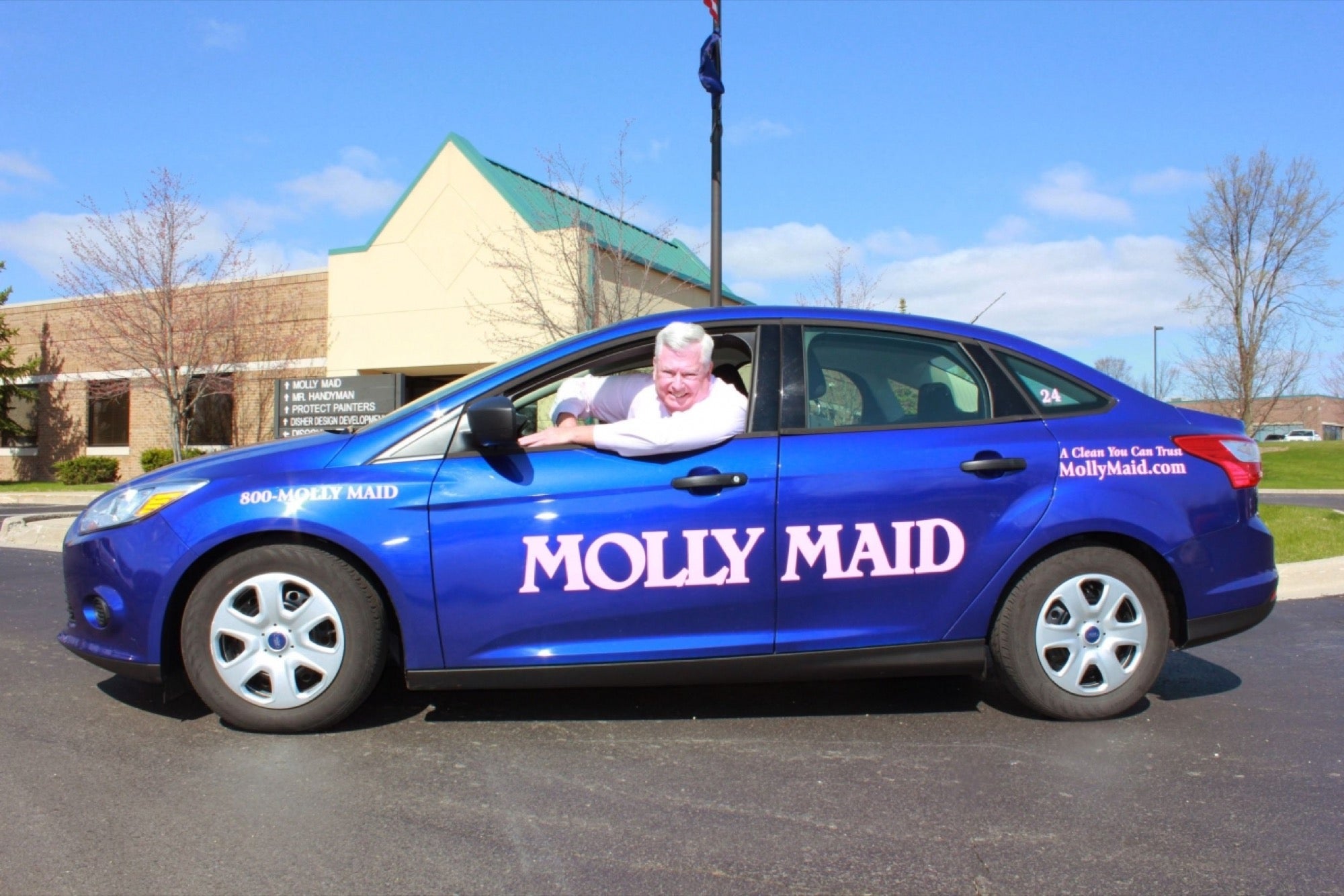

Molly Maid is a leading residential cleaning franchise known for reliable, professional service. Founded in 1979 in Mississauga, Canada by Adrienne and Chris Stringer, it expanded into the United States in 1984 under entrepreneur David McKinnon in Ann Arbor, Michigan.
Today, the franchisor’s U.S. headquarters are in Waco, Texas, and Molly Maid is part of the Neighborly family of brands. The franchise began offering franchise opportunities in 1979 and now operates over 440 independently owned locations.
Molly Maid specializes in recurring and one-time residential cleaning services. It offers flexible plans including eco-friendly cleaning, move-in/move-out services, apartment and condo cleaning, and light commercial cleaning.
Here's what you would need to invest if you were to start this franchise. These costs are provided by the franchisor in the Franchise Disclosure Document.
Molly Maid provides several structured training programs to franchisees as part of their pre-opening and ongoing support. The training components are outlined under Item 11 of the Franchise Disclosure Document (FDD). Here are the key training programs offered by the Franchisor:
Molly Maid provides its franchisees with limited territory protection under the Franchise Agreement. Each franchisee is assigned a defined territory based on U.S. ZIP Codes, and the value of that territory is calculated using a point system derived from demographic factors, such as household income and other criteria.
This territory, once assigned, remains protected for the franchisee even if the local population grows, unless the agreement is amended to include new ZIP Codes. The point system determines the “Target Household” (TH) total for the territory, which is then used to calculate the Territory Fee (typically $1.00 per TH).
Standard territories generally contain between 45,000 to 70,000 TH, translating into fees between $45,000 and $70,000. While this setup grants exclusivity within the defined territory, Molly Maid retains the discretion to adjust the TH based on specific market conditions or business needs.
Below are some of
Molly Maid
key competitors in the
Commercial Cleaning
sector.
448
$14,900
$140,000
$197,000
n.a.
$759,000
$xxx,xxx
n.a.
n.a.
n.a.
n.a.

Cleanest Restaurant Group is a restaurant cleaning service franchise offering specialized front- and back-of-house deep cleaning, serving full-service and quick-service restaurants, and known for niche expertise, proprietary cleaning solutions, low-competition territories, and recurring nighttime service contracts.
?
?

CleanNet is a commercial cleaning franchise offering janitorial and facility-maintenance services to offices and industrial properties, serving business clients and operators, and known for proprietary systems, national account support, and scalable operations.
?
?

You've Got Maids is a residential cleaning franchise providing professional maid services with a focus on eco-friendly practices and exceptional customer service.
?
?

Renue is a commercial cleaning and sanitization franchise specializing in deep cleaning and surface restoration for hotels, healthcare facilities, and offices.
?
?

Buildingstars provides commercial cleaning and janitorial services, focusing on quality and customer satisfaction to maintain clean and professional workspaces.
?
?

Sparkle Squad provides residential and commercial window cleaning services. Their eco-friendly solutions and professional techniques leave windows spotless and sparkling.
?
?
Choosing a franchise goes beyond reviewing fees and financials — it requires an honest assessment of your goals, skills, and risk tolerance. This article outlines the key questions prospective owners should ask before committing. It helps clarify whether the opportunity aligns with your lifestyle, long-term plans, and operational preferences.
Speaking with current and former franchisees is one of the most reliable ways to understand how a franchise really operates. This guide explains how to conduct validation calls, what questions to ask, and how to identify patterns in feedback. It provides a practical framework for uncovering real performance expectations and support quality.
Not all franchise opportunities offer the same potential. This article breaks down how to evaluate a brand’s industry, financial health, support systems, and competitive positioning. It helps prospective buyers compare options and identify franchises with strong long-term viability.
A clear, well-structured business plan is essential for securing financing and preparing for the realities of franchise ownership. This article explains how to build a plan that covers market analysis, operations, staffing, and local marketing. It also outlines how to create realistic pro forma financials, including revenue projections, startup costs, and break-even analysis. Readers gain a practical framework they can use when applying for loans or planning their first years of operations.