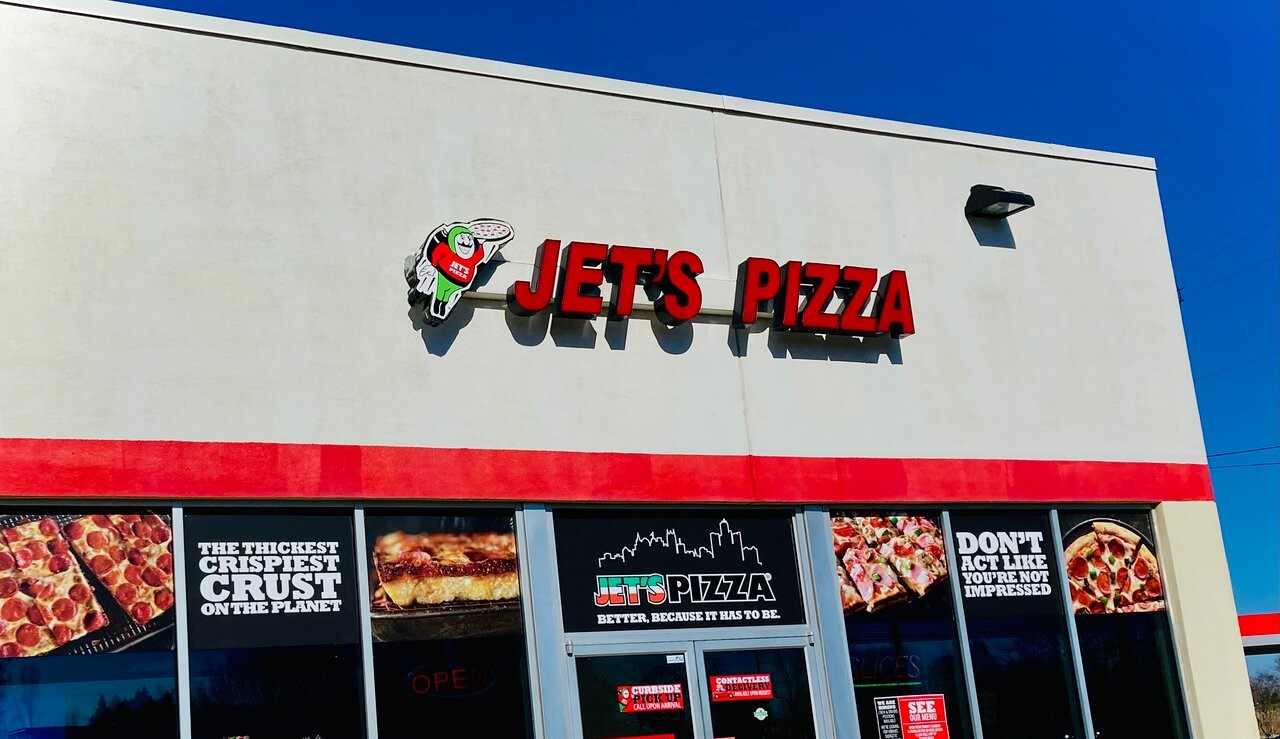
Jet's Pizza is a pizza franchise that offers a variety of specialty pizzas, wings, salads, and subs for dine-in, takeout, and delivery, using fresh ingredients and handcrafted dough for delicious and satisfying meals.
KEY FRANCHISE STATS
Franchisees
?
413
+
12%
12%
Franchise fee
?
$30,000
Investment
?
$628,000 - $843,000
Revenue (AUV)
?
Undisclosed
$0
+
n.a.
n.a.
Sign up
Jet’s Pizzabegan in 1978 in Sterling Heights, Michigan, when Eugene Jetts, initially on a search for a new house, chose instead to lease a storefront and open a pizzeria. Teaming up with his brother John Jetts, they launched what was first known as Jetts Party Shoppe & Pizzeria—later evolving into the popular Jet’s Pizza brand.
The business quickly gained a following thanks to its authentic Detroit-style pizza, recognized for its thick, square crust with crispy edges. In 1990, the company began franchising, signaling the start of its growth beyond Michigan.
While its deep-dish Detroit-style pizza remains the hallmark, the menu also features hand-tossed round, thin-crust, and New York-style options, as well as a variety of salads, breads, and desserts.
Jet’s distinguishes itself through its commitment to premium ingredients, including vine-ripened tomatoes and mozzarella cheese of the highest quality.
Interested in Jet's Pizza franchise?
Share your information and our team will help you explore Jet's Pizza franchise opportunity, including startup costs, available territories, ownership requirements, and next steps.
The initial investment required for a Jet's Pizza franchise is
$628,000 - $843,000.
That is the total cost you would need to finance if you were to start this franchise.
These costs are provided by the franchisor in the Franchise Disclosure Document.
Type of Expenditure
Amount
Initial Franchise Fee
$15,000 or $30,000
Travel and living expenses while training
$9,000 to $15,000
Security deposit
$4,000 to $10,000
Rent - 3 months
$7,500 to $20,000
Blueprints
$10,000 to $15,000
Leasehold improvements
$300,000 to $400,000
Fixtures and equipment
$175,000 to $225,000
POS System
$20,000 to $30,000
Computer maintenance costs
$1,500 to $2,000
Miscellaneous opening costs
$3,000 to $6,000
Opening inventory
$12,000 to $14,000
Insurance
$10,000 to $16,000
Working Capital/Additional funds - 3 months
$60,000
Total Estimated Initial Investment
$627,500 to $843,000
Create a free account to access this table and more.
Thank you! Your submission has been received!
Oops! Something went wrong while submitting the form.
Type of Expenditure
Amount
Initial Franchise Fee
$15,000 or $30,000
Travel and living expenses while training
$9,000 to $15,000
Security deposit
$4,000 to $10,000
Rent - 3 months
$7,500 to $20,000
Blueprints
$10,000 to $15,000
Leasehold improvements
$300,000 to $400,000
Fixtures and equipment
$175,000 to $225,000
POS System
$20,000 to $30,000
Computer maintenance costs
$1,500 to $2,000
Miscellaneous opening costs
$3,000 to $6,000
Opening inventory
$12,000 to $14,000
Insurance
$10,000 to $16,000
Working Capital/Additional funds - 3 months
$60,000
Total Estimated Initial Investment
$627,500 to $843,000
Franchise Disclosure Document
Below is Jet's Pizza's 2026 Franchise Disclosure Document. Sign up for free to view the document.
Number of units
Jet's Pizza had 474 total units in 2026, of which 413 were franchised-owned and 61 company-owned.
Jet’s Pizza offers a comprehensive training system to ensure that franchisees and their staff are fully equipped to operate a successful location. The programs include initial, ongoing, and optional training components supported by hands-on experience and company-led seminars.
Initial Training Program This six-week course includes classroom and hands-on training at a Jet’s Pizza location in Michigan, provided six days a week. It covers all operational aspects, including food preparation, systems management, and customer service. Training for two individuals is included in the initial franchise fee, and additional trainees incur a separate charge.
Manager Replacement Training If a trained manager leaves, the franchisee must promptly hire a replacement who has either completed Jet’s training or possesses equivalent skills. If training is required, the franchisee pays the standard training fee.
Ongoing and Mandatory Training Jet’s Pizza may require franchisees or designated employees to attend future training courses, seminars, or webinars, either in-person or virtually. These events cover updates to products, services, and operational procedures and may involve additional fees.
Territory Protection
Jet’s Pizza provides franchisees with a defined territory of 1.5 miles around the approved location (or 0.25 miles in New York City and Chicago). Within this area, Jet’s Pizza agrees not to license or operate another traditional Jet’s Pizza restaurant during the agreement term, offering a degree of protection.
However, this protection is limited and conditional on compliance with the franchise agreement.
The franchise territory is explicitly non-exclusive. Jet’s retains the right to operate or license “Non-Traditional Restaurants” within the same area, including food trucks, locations in malls, stadiums, airports, and other non-standard venues



.png)
.png)